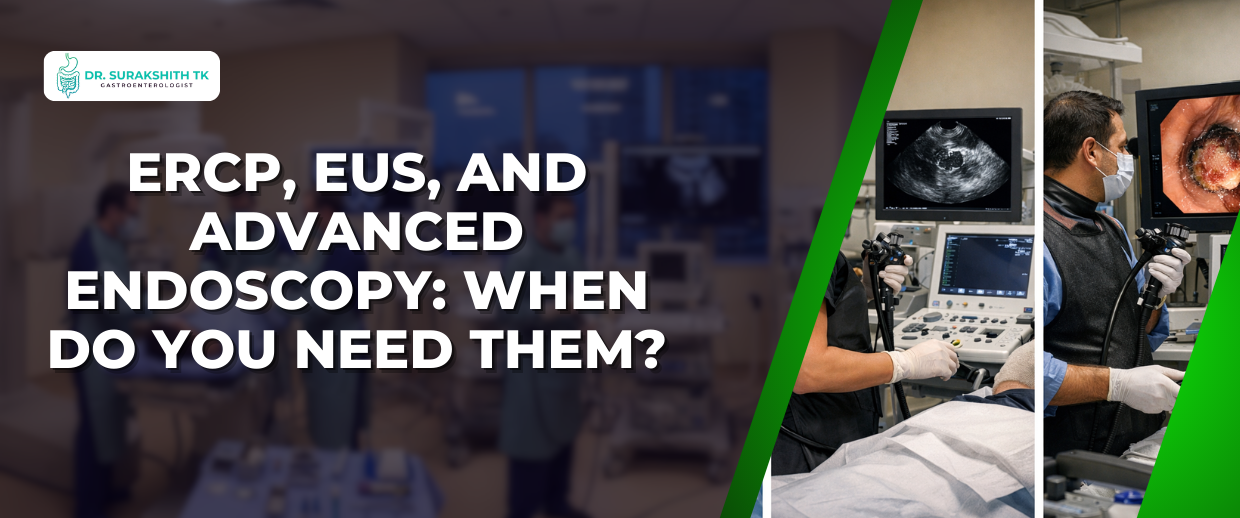
Learn when ERCP, EUS, and advanced endoscopy procedures are necessary. Discover symptoms, conditions treated, and how these diagnostic tools can help detect digestive disorders early.
By : Dr. Surakshith T K
ERCP, EUS, and Advanced Endoscopy: When Do You Need Them?
Introduction
When it comes to diagnosing and treating complex digestive disorders, standard endoscopy procedures sometimes aren't enough. Advanced endoscopic techniques like ERCP (Endoscopic Retrograde Cholangiopancreatography) and EUS (Endoscopic Ultrasound) have revolutionized how gastroenterologists diagnose and treat conditions affecting the pancreas, bile ducts, and digestive tract. But how do you know when you need these specialized procedures? This comprehensive guide will help you understand these advanced techniques and when they become necessary.
Understanding Advanced Endoscopy
Advanced endoscopy goes beyond routine upper endoscopy or colonoscopy. These specialized procedures combine diagnostic imaging with therapeutic interventions, allowing doctors to both identify and treat complex gastrointestinal conditions in a single session. Unlike traditional endoscopy, which primarily examines the inner lining of digestive organs, advanced techniques provide deeper insights into surrounding tissues, ducts, and organs.
What is ERCP and When Do You Need It?
ERCP is a sophisticated procedure that combines endoscopy with X-ray imaging to examine and treat problems in the bile ducts, pancreatic ducts, and gallbladder. During the procedure, a flexible endoscope is passed through your mouth, down the esophagus, through the stomach, and into the duodenum, where the bile and pancreatic ducts open.
You may need ERCP if you experience:
Unexplained jaundice (yellowing of skin and eyes) accompanied by dark urine and pale stools often indicates bile duct obstruction. This could be caused by gallstones, tumors, or strictures that block bile flow. Severe upper abdominal pain that radiates to your back, especially when associated with elevated liver enzymes or bilirubin levels, warrants investigation through ERCP.
Recurrent pancreatitis without a clear cause requires detailed examination of the pancreatic duct system. ERCP can identify structural abnormalities, stones, or blockages that trigger repeated inflammation. If you've been diagnosed with pancreatic or bile duct stones, ERCP isn't just diagnostic—it's therapeutic. Doctors can remove stones, place stents to keep ducts open, or perform sphincterotomy to improve drainage.
Suspected bile duct cancers or tumors require accurate diagnosis and staging. ERCP allows tissue sampling and can provide immediate relief by placing stents to bypass blockages.
Chronic liver disease patients with concerns about primary sclerosing cholangitis benefit from ERCP's detailed visualization of bile duct changes.
ERCP can treat conditions like:
Removing gallstones stuck in bile ducts
Placing stents to bypass strictures or tumors
Dilating narrowed ducts
Stopping bleeding from bile or pancreatic ducts
Draining pseudocysts
What is EUS and When Is It Necessary?
Endoscopic Ultrasound combines endoscopy with high-frequency sound waves to create detailed images of your digestive tract wall and surrounding organs. The ultrasound probe at the tip of the endoscope can get much closer to organs than an external ultrasound, providing superior image quality.
EUS becomes necessary when:
Your doctor suspects pancreatic lesions or tumors that aren't clearly visible on CT or MRI scans. EUS can detect pancreatic masses as small as 2-3 millimeters and allows fine-needle aspiration for tissue diagnosis. If you're experiencing unexplained weight loss, persistent abdominal pain, or new-onset diabetes after age 50, EUS helps rule out pancreatic cancer.
Submucosal tumors in the digestive tract wall—lumps that grow beneath the inner lining—require EUS for accurate characterization. The procedure determines whether these growths originate from muscle layers, nerve tissue, or other structures, guiding treatment decisions.
Staging of gastrointestinal cancers is another critical application. EUS provides precise information about how deeply cancer has invaded the digestive tract wall and whether nearby lymph nodes are involved. This information is crucial for determining whether surgery, chemotherapy, or radiation therapy is most appropriate.
Chronic pancreatitis evaluation benefits from EUS's ability to detect early changes in pancreatic tissue before they appear on standard imaging. If you have recurrent abdominal pain with normal CT scans, EUS might reveal chronic pancreatitis features that explain your symptoms.
Bile duct stones that are difficult to visualize with other imaging methods can be accurately detected with EUS. The procedure also evaluates ampullary tumors and can guide drainage procedures for pancreatic fluid collections.
EUS can also perform therapeutic interventions:
Draining pancreatic pseudocysts
Performing celiac plexus blocks for pain management
Obtaining tissue samples through fine-needle aspiration
Placing fiducial markers for radiation therapy planning
Other Advanced Endoscopy Techniques
Beyond ERCP and EUS, several specialized procedures address specific conditions. Capsule endoscopy involves swallowing a pill-sized camera that captures thousands of images as it travels through your digestive tract, ideal for examining the small intestine. Double-balloon enteroscopy uses specialized endoscopes to reach deep into the small intestine for diagnosis and treatment of bleeding, tumors, or Crohn's disease.
Endoscopic submucosal dissection removes early-stage cancers or large polyps that can't be removed with standard techniques. Peroral endoscopic myotomy treats swallowing disorders like achalasia by cutting muscle fibers from inside the esophagus, avoiding external incisions.
Who Should Perform These Procedures?
Advanced endoscopy requires specialized training beyond a standard gastroenterology fellowship. These procedures carry higher risks than routine endoscopy and demand extensive experience for optimal outcomes. When seeking care, consulting with the Best Gastroenterologist in South Delhi ensures you receive expert evaluation to determine if advanced endoscopy is necessary for your condition.
The Best Gastroenterologist in South Delhi will have completed additional training in advanced endoscopic techniques and perform these procedures regularly. High-volume centers with experienced specialists have better outcomes and lower complication rates for complex procedures like ERCP and EUS.
Preparing for Advanced Endoscopy
Preparation varies by procedure type. ERCP typically requires fasting for at least six hours and may need blood tests to check clotting function. You'll receive sedation or anesthesia, so arrange transportation home. EUS preparation is similar to standard upper endoscopy—fasting and sedation—but the procedure takes longer.
Your doctor will review your medications, especially blood thinners that may need temporary discontinuation. Discuss any allergies, particularly to iodine contrast dye used during ERCP. Understanding the risks, benefits, and alternatives helps you make informed decisions about your care.
Recovery and Follow-Up
Most patients go home the same day after an advanced endoscopy. You'll need someone to drive you due to sedation effects. Mild throat discomfort, bloating, or cramping is normal and resolves within 24 hours. Your doctor will discuss preliminary findings immediately, with complete results available once pathology and imaging are reviewed.
Serious complications are rare but include pancreatitis after ERCP, bleeding, infection, or perforation. Contact your doctor immediately if you develop severe abdominal pain, fever, vomiting, or bleeding after the procedure.
Making the Right Decision
Not everyone with digestive symptoms needs advanced endoscopy. Your gastroenterologist will consider your symptoms, medical history, previous test results, and overall health when recommending these procedures. Standard imaging, like CT, MRI, or basic endoscopy, often provides sufficient information for diagnosis and treatment.
However, when complex conditions affecting the pancreas, bile ducts, or deep tissue layers are suspected, advanced endoscopy offers unparalleled diagnostic accuracy and treatment options. Finding the Best Gastroenterologist in South Delhi who specializes in these techniques ensures you receive appropriate care tailored to your specific needs.
Conclusion
ERCP, EUS, and other advanced endoscopic procedures represent significant advances in diagnosing and treating complex digestive disorders. While not needed for every patient, these techniques provide invaluable information and treatment options when standard approaches fall short. If you're experiencing unexplained jaundice, chronic pancreatitis, suspected pancreatic lesions, or other complex gastrointestinal issues, consultation with the Best Gastroenterologist in South Delhi can help determine whether advanced endoscopy is right for you. Earlydiagnosis through appropriate testing leads to better outcomes and more effective treatment strategies for challenging digestive conditions.
FAQs
Q1: Is ERCP painful?
A: No, ERCP is performed under sedation or anesthesia, so you won't feel pain during the procedure. Some mild discomfort afterward is normal.
Q2: How long does EUS take?
A: EUS typically takes 30-60 minutes, though complex cases may require more time. You'll spend additional time in recovery from sedation.
Q3: Are there risks with advanced endoscopy?
A: While generally safe, risks include pancreatitis (ERCP), bleeding, infection, and perforation. Experienced specialists have very low complication rates.
Q4: Can I eat after the procedure?
A: You can usually resume eating once sedation wears off and your doctor approves, typically within a few hours for EUS or the next day for ERCP.
Q5: Will insurance cover these procedures?
A: Most insurance plans cover medically necessary ERCP and EUS when appropriately indicated by your gastroenterologist. Check with your provider beforehand.
Dr. Surakshith T K
Specialist Gastroenterologist and Hepatologist
Dr. Surakshith T K is a leading gastroenterologist and hepatologist
with 12+ years of experience, specializing in advanced endoscopic procedures including
POEM, ERCP, EUS, ESD/EMR, and bariatric endoscopy. He is known for expert care in GI,
liver, pancreatic, and biliary disorders with a strong focus on early cancer detection.